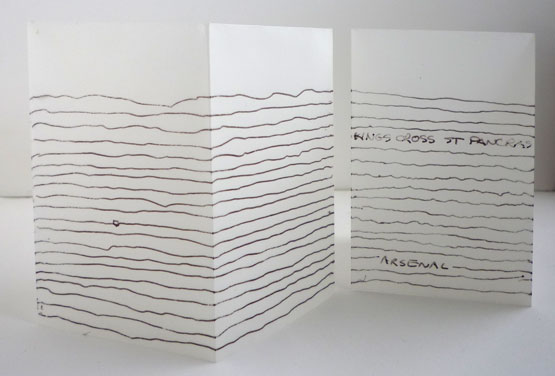
Are they buildings or towers - or vessels? Do they work as a vehicle? I like the continuous line but making it requires constant turning over of the paper, which interrupts the flow more than changing the direction of the writing does.
From Piccadilly Line to Central Line, and from Central Line to street level.
(In March 2010 I could run up 43 steps on the first escalator, and up 107 steps in all. Since finishing the art foundation course I no longer run up the escalators three times a week; my performance has definitely declined.)
The travelwriting continues - it has moved not just from the page to fabric, but from flat fabric into useful items - bags, pouches, and tool rolls for carrying your portable necessities with you. See the Travel Lines London collection on its new website - www.travel-lines-london.co.uk.
Why a wiggly line?
The idea for "journey lines" may have been triggered by the daily "process drawings" of artists like Marcia Hafif and Bridget Riley. I started drawing while riding on the underground after seeing some work by Lucy Skaer that consisted of repeated motifs filling a large sheet of paper ... trying to make some motifs of my own.
This evolved into an intention to simply draw a line that was as long as possible, on any bus, train, or tube journey.
Part of my project is to document these journeys on this blog – much as land artists like Richard Long document their journeys to have a record of the ephemeral work. But the journey lines are not themselves a documentation; they are a way of marking time, recording and making permanent the duration of the all-too-forgettable daily journey.
Drawing these lines is a way of being present in the daily journey - and of using "wasted" time.
Focusing on this drawing/writing gives a breathing space, away from everyday demands, yet part of the everyday routine, and a way of attending to the "disregarded everyday".